Printable Couples Conflict Workbook for Calmer Arguments

When arguments keep repeating
Recurring fights often aren’t about the “topic” on the surface—they’re about the pattern underneath it. Many couples get pulled into a predictable loop: a trigger lands, assumptions fill in missing details, voices rise or go quiet, one partner pursues while the other withdraws, and the conversation ends with resentment instead of resolution.
The hard truth is that “winning” an argument rarely meets the deeper need that started it. Most repeated conflicts trace back to a need for safety, respect, reliability, or reassurance. When those needs feel threatened, the brain prioritizes protection over connection—so partners start collecting evidence, defending, or shutting down.
A structured tool is especially helpful when:
- Conversations go off-track within minutes.
- Old topics pile onto new ones and nothing gets finished.
- Apologies happen, but behavior doesn’t change afterward.
- You both feel misunderstood even when you’re trying.
How a workbook changes the conversation
A printable conflict-resolution workbook creates a shared process. Instead of relying on whoever can talk faster (or stay calmer longer), both partners follow the same steps: slow down, name the issue, translate reactions into needs, and end with a concrete agreement.
It also reduces overwhelm by breaking one conflict into smaller pieces—facts, feelings, needs, requests, and agreements. That structure makes it easier to stay specific, so the conversation doesn’t spiral into “you always” and “you never.” Over time, those steps become habits you can use in everyday moments: quick tone checks, paraphrasing, and repair attempts that stop damage from accumulating.
Finally, written agreements support accountability. When something slips, you can revisit what you both chose—without turning it into a character critique.
What to do during a conflict: quick map
| Step | Goal | Example prompt |
|---|---|---|
| Pause and regulate | Lower intensity so listening is possible | “On a 0–10 scale, where am I right now?” |
| Name the topic | Keep it specific and time-bounded | “This is about yesterday’s plans changing.” |
| Share impact | Express feelings without attacks | “I felt dismissed when…” |
| Reflect back | Prove understanding before responding | “What I’m hearing is…” |
| Identify the need | Move from complaint to core need | “I need reliability / reassurance / respect.” |
| Make a request | Ask for a concrete behavior | “Next time, can you text me before changing plans?” |
| Agree and follow up | Turn it into an action and a check-in | “Let’s try it this week and review on Sunday.” |
Improve listening without losing your point
Better listening doesn’t mean surrendering your perspective. It means slowing the pace enough to understand what your partner is actually saying—so you can respond to the real issue, not the version your nervous system guessed.
- Use reflective listening: summarize their meaning before adding yours. A simple “So you felt cornered when I brought it up in front of friends?” can change the whole tone.
- Ask clarifying questions: reduce mind-reading with “When you say X, do you mean Y?”
- Swap rebuttals for validation: you can acknowledge emotion even if you disagree on details: “I can see why that felt disrespectful.”
- Try a timed format: 3 minutes speaker / 3 minutes listener, then switch. Timers prevent steamrolling and help quieter partners stay engaged.
For additional research-based relationship tools, resources from the Gottman Institute and guidance on healthy communication from the American Psychological Association can be useful complements.
Resolve arguments with fewer explosions
Many blowups aren’t caused by “big issues,” but by escalation without guardrails. Agreeing on a few rules ahead of time can keep a solvable conflict from becoming a rupture.
- Set fight rules when you’re calm: no name-calling, no threats, no bringing up unrelated past issues.
- Use a reset phrase: “Pause—same team” or “Let’s restart softer.” Treat it as a shared safety tool, not a shutdown.
- Pick one solvable piece: decide what changes next time rather than relitigating the whole history.
- End with a repair attempt: appreciation, apology, or a small act of care. Repair doesn’t erase the issue—it keeps connection intact while you work on it.
Rebuild trust through consistent repair
Trust usually returns through patterns, not a single “perfect talk.” The fastest way to rebuild safety is to create small, measurable commitments that are easy to keep and easy to revisit.
If there is fear, coercion, emotional harm, or physical harm, prioritize safety and seek professional support. The National Domestic Violence Hotline provides confidential help and resources.
Printable routine: a 7-day reset plan
When to get extra support
Recommended picks for calmer, more productive conversations
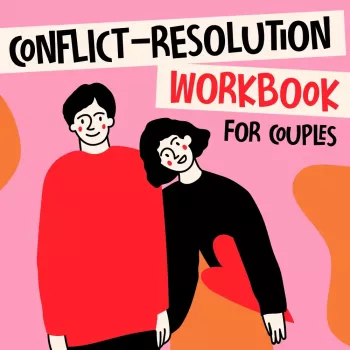
- Conflict-Resolution Workbook for Couples | Printable Relationship Communication eBook | Improve Listening, Resolve Arguments, Rebuild Trust — a structured, printable format for slower talks, clearer requests, and written follow-through.
- Minimalist Acrylic Side Table — a simple way to set up a “conversation corner” with a notepad, timer, and water so talks feel intentional (not ambush-style).
- Modern Gold Stainless Steel Coffee Table — a dedicated surface for weekly check-ins can help keep agreements and notes in one consistent place.
FAQ
How do couples use a conflict-resolution workbook without turning it into another argument?
Use it at a calm time, agree on one topic only, and set rules like no interruptions and no sarcasm. If either person’s intensity gets too high, take a timed break and resume after you’ve both regulated.
Can a printable workbook help rebuild trust after repeated fights?
Yes—written agreements and weekly check-ins make repair measurable, and consistent follow-through is what rebuilds trust over time. If safety is an issue or there’s ongoing coercion or harm, use professional support alongside any workbook.
What if one partner shuts down or gets defensive during the exercises?
Shorten the sessions, add regulation breaks, and lead with validation before problem-solving. Practicing on low-stakes topics first can build confidence, and a therapist or mediator can help if you keep getting stuck.















Leave a comment