20lb Propane Tank Runtime for Tankless Water Heaters
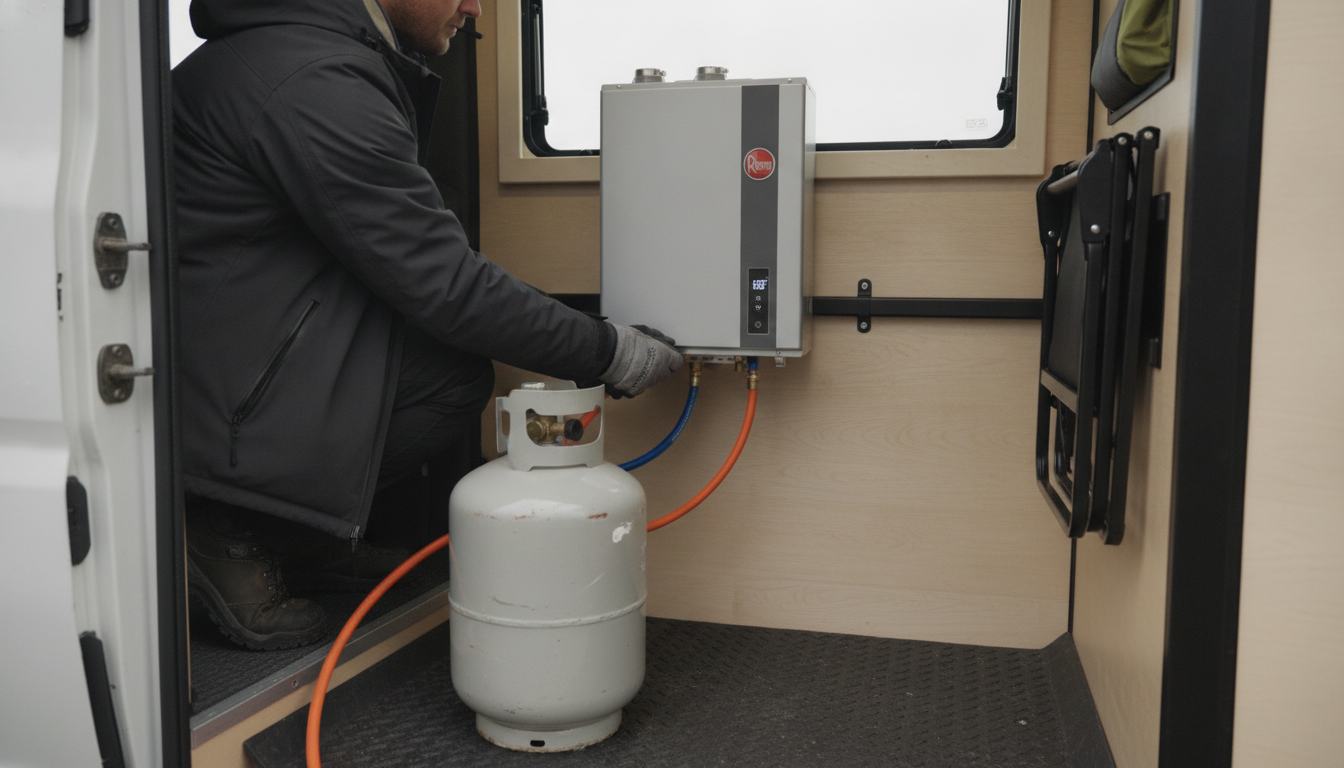
How long will a 20lb propane tank run a tankless water heater?
A standard 20lb propane cylinder holds about 4.7 gallons of propane. Since propane contains roughly 91,500 BTU per gallon, a full tank provides around 430,000 BTU of fuel (before appliance efficiency is considered).
If your tankless water heater is rated around 180,000 BTU and it were to run at full fire continuously, the math is straightforward: 430,000 ÷ 180,000 ≈ 2.4 hours of burner-on time. Real-world runtime is often longer because tankless heaters modulate their burner output and don’t run at maximum BTU most of the time.
What “2.4 hours” actually means in daily use
Tankless propane units only burn fuel while hot water is flowing. That means your 20lb tank isn’t giving you just a couple hours of “calendar time”—it’s giving you a couple hours of maximum-output heating time spread across many hot-water draws.
For example, a single shower might make the heater run at moderate-to-high output for 10–20 minutes depending on your flow rate and temperature rise. Dishwashing or handwashing usually uses shorter bursts. If your incoming water is very cold or you’re running multiple fixtures at once, the heater will ramp closer to its maximum BTU and you’ll use the tank faster.
Factors that change propane runtime
Temperature rise: Winter groundwater temperatures can force higher burner output.
Flow rate: Higher gallons-per-minute generally equals more fuel burned.
Set temperature: A higher setpoint increases energy use.
Heater size: Larger BTU units can burn through a small cylinder quickly when pushed hard.
For a practical look at how a high-output indoor LP tankless heater is sized and used, see this guide: 9 GPM 180,000 BTU indoor LP tankless heater guide.
FAQ
Does a tankless water heater use propane only when hot water is running?
Yes. A tankless heater ignites and burns propane when there’s a demand for hot water, then shuts down when the flow stops. It may use a small amount of electricity for controls and ignition, but propane consumption happens during heating.













Leave a comment